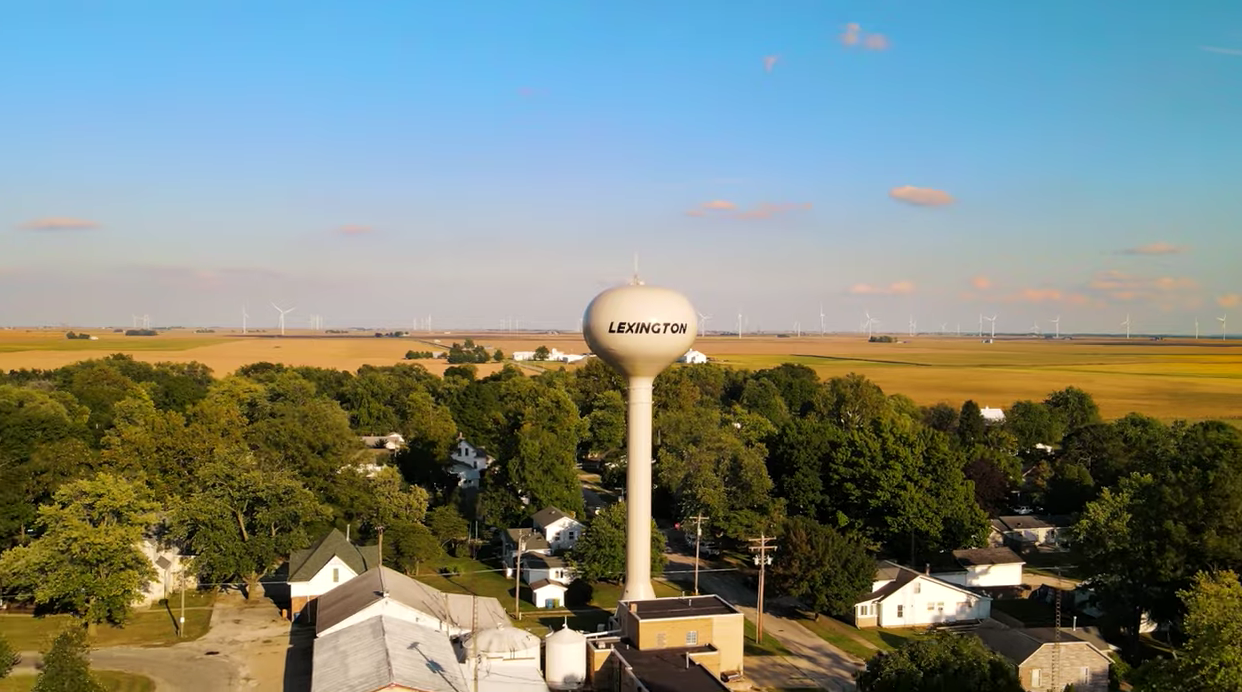
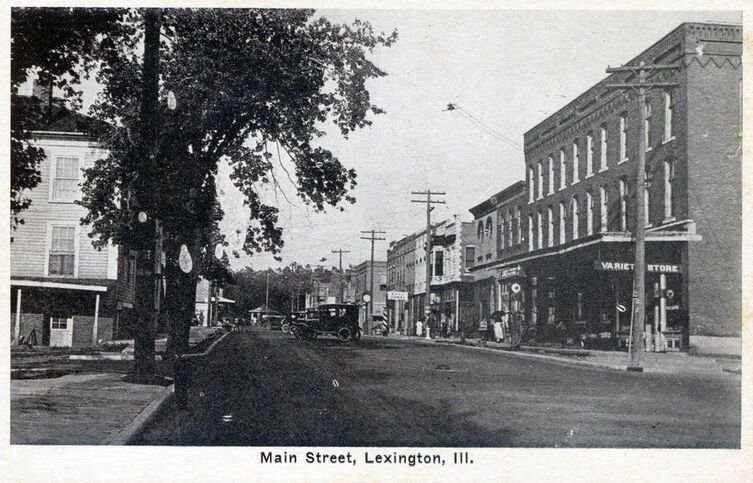

The Rise and Decline of Lexington’s Gas Stations
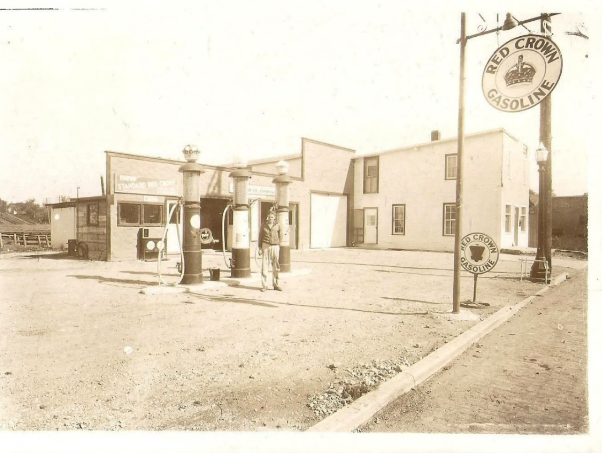
(Henry “Hank” Hallstein in front of his Service Station, circa 1930s, Source: Rick Worth)
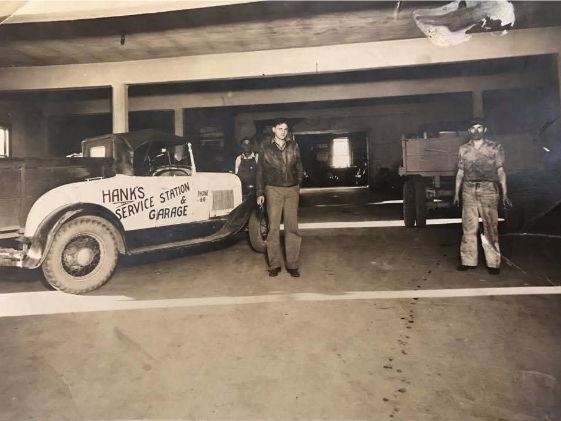
(Hank’s Garage lower level, circa 1940s, Source: Worth family image)
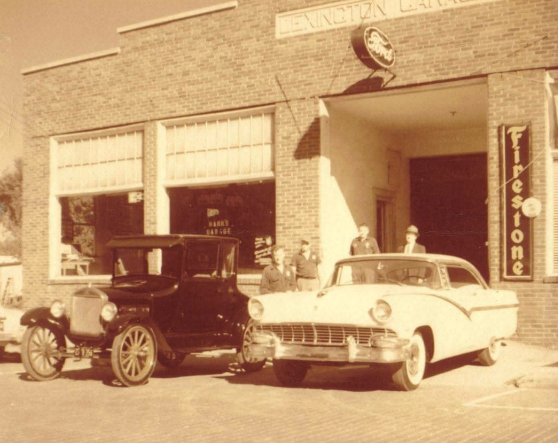
(Ford Garage, circa 1940s, Source: Worth family)
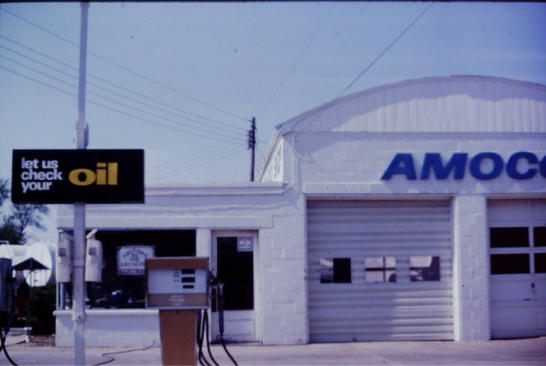
(Fasking Amoco, circa 1976, Source: Fasking family photo)
The Rise and Decline of Lexington's Gas Stations
Before a few large chains sold gasoline from outposts near Interstate exits, gas and service stations were Main Street businesses. Travelers would be immersed right in the downtown of the communities they frequented to fill their cars with gasoline. Lexington, Illinois was a community that ran on gasoline. Between 1950 and 1980, Lexington's population almost doubled, largely due to the automobile. As many as nine separate gas stations operated at the same time during the heyday of Route 66 traffic through Lexington.
Filling Stations: A Genesis
These filling stations were central to life and the local economy in a way they aren’t in contemporary life. For the first three quarters of the 20th century, filling stations, like the majority of traffic, flowed directly through most towns and cities. A small town like Lexington’s downtown would be a-bustle all day with all sorts of newcomers, travellers, and truckers moving through the city. Traffic would not simply pass by the outskirts on a large, fast interstate like it does today. Cars, we can easily forget, are fairly new. The use, service, and maintenance of automobiles is not ancestral. Cars brought the far near, but disrupted the old patterns of transportation and travel by foot, horse, or train of the previous generations. Cars brought ease, convenience, and excitement to a world rapidly changing. The filling station is, in many ways, an almost allegorical representation of the changes in Lexington life in the 20th century.
Filling stations began as a somewhat haphazard and ill-defined business, with gas pumps being added to grocery stores, mechanic garages, and other homes or businesses. Automobiles began as technology built on top of the existing infrastructure. Existing roads were updated or paved over, businesses opened up and down Main Street and into the town square catering to the arrival of cars. A few lucky citizens became car owners, often buying from local dealers. Between 1926 and 1945, rapidly, new infrastructure began to emerge to serve the needs of the driver. Route 66 (Formerly Route 4) and many similar routes around the country were built specifically for the automobile. The communities along the bustling motorway had to respond by expanding their own infrastructure. New filling stations, hotels, and restaurants brought new money and new business to small communities. In the 40s, 50s, and 60s, filling stations were built to stand out among competitors. They provided car services, sold sodas, and became as unique and quirky as the communities they served. Then, as the interstates displaced the old two-lane highways and made entry/exit from the road difficult and regulated, filling stations moved out of town to serve the highways and expanded in size and scale to serve the appetite for convenience that defined late 20th century America.
Genesis of the Motorcar in Lexington
Lexington’s relationship with the motorcar doesn’t start with Route 66. As the first automobile drove through McLean County in the early 1910s, Lexington was already responding. Grant Preble had opened an auto repair service on North Pine Street by 1913. In 1916, records show “the Lexington Garage” having a manager. Former Mayor George E Brown operated “George’s Garage” near the park. George Becker was working as a mechanic by 1919, A. O. Rogers was advertising auto repair by 1920, and the Carnahan family had opened two separate repair shops by 1925. The town was starting to respond to a world being remade by car travel. And within the next year, the doors were about to blow wide open.
1926
Route 66 came through Lexington in 1926 and set off a boom in local filling stations. When the highway was officially designated in 1926, it ran straight through the heart of Lexington along West Main Street and out Grove Street, putting the town directly on the main artery of cross country travel. Countless truckers, families, and travelers would make for the booming West Coast using this new road, delightfully known as the Mother Road. The flatness and accessibility of Route 66 made it a popular truck route, and the trucking industry stimulated the local economies it drove through, with small outposts of hotels, restaurants, and filling stations springing up quickly in response. Lexington was no exception. Through the 1920s and 1930s, gas stations multiplied across town. Zack Garrett operated a station at the corner of West Main and Grove in the early 1920s. John Montgomery had an oil station at Route 66 and North Street by 1926. Charles Stevenson ran a station at Lee and Wall. Dan Stamm opened a Shell station on Main in 1930 before transitioning to Cities Service. Nathan Hardman ran a Texaco at Walnut and Route 66, and Ida Hardman operated a Texaco as early as 1927. The names kept coming: Standard, Mobil, Conoco, Phillips 66, Skelly, White Rose. Nearly every major oil brand had a flag flying in Lexington at some point in the early days of Route 66.
Postwar Boom
The 1940s brought both wartime disruption and the American postwar boom. Operators cycled in and out of the same locations with remarkable frequency. The station at 508 West Main passed through the hands of Lloyd Worth, Joseph Girard, Ralph White, Larkin Pool, Jim Hanley, Allen Gleeson, and Eldon Atkins all within roughly a decade. Some operators held on while their business partners went to war. Others were new entrepreneurs seizing on the postwar appetite for the open road. A 1946 travel guide noted Lexington as a "small business district with gas stations, etc., garage but no hotel," capturing the town's identity as a pit stop on Route 66. Not exactly a glowing review, but to be included in a travel guide at the time was novel press for the small community.
The 1950s were the peak of Americana car culture in every way. The baby boom was in full swing, the economy was soaring under the new deal, and a collective popular youth culture was forming for the first time in history. It was a time of energy, optimism, and commerce. Filling stations pumped cheap gas into American-made automobiles coming from the factories of Detroit, Indiana, and Pennsylvania. In Lexington, Carl Christianson ran a Texaco with an attached motel. Woody Blair's Skelly station sat alongside the Mesa Café on the Route 66 bypass. Earl "Andy" Anderson pumped gas at the Skelly through the decade. In Lexington in the 1950s, a town of 1,100 people at the time, there were simultaneously as many as nine active stations and garages. Lexington was riding high and fast on the Route 66 economy.
Fasking’s Standard: The Fasking Legacy on Main Street
Perhaps no establishment better embodies the arc of Lexington's filling station era than the Fasking filling station on Main Street, the building still standing in its former glory (though no longer in operation). In April of 1948, William "Bud" Fasking took over the Standard Oil station at 506-507 W. Main from Henry "Hank" Hallstein, renaming it Fasking's Standard. Bud had already been working in the trade, doing body work out of the lower level of Hank's garage next door under his uncle Bill Simpsen. The Fasking family initially lived in the old lumber office building adjacent to the station before Bud remodeled a residence on S. West Street in 1951 and moved the family there.
In the mid-1950s, Bud undertook a major transformation of the property. He converted the original frame station to a block structure with a distinctive humped roof, and around 1957 added an additional bay on the east side of the building. What had been a modest operation was growing in the postwar boom. The station changed oil from Standard to Amoco over the decades, but the family name above the doors stayed the same. Bud ran a full-service gasoline and auto body operation and his son Bill eventually carried the business forward into the next generation.
Bill Fasking continued operating Fasking's Amoco and the adjoining body shop until December1998, when EPA regulations requiring expensive upgrades to underground fuel storage tanks finally forced the station to close after half a century of continuous family operation. Even after closing, Bill leased the building to other automotive businesses before selling the property in 2006.
The Convenience Corridor
Then came the bypass. The beginning of the decline for Route 66 came in 1956 with the signing of the Interstate Highway Act, and for a town like Lexington, the consequences were felt over the following two decades. The opening of the freeway led to the closure of the Skelly station in the late 1970s. Route 66 was the path less traveled, left in increasingly worse disrepair, and officially removed from the U.S. Highway System on June 27, 1985. One by one, the independent stations around Lexington and around the country closed. The national taste moved away from mom-and-pop shops and many businesses had to “get big or get out” to keep up with the pace of the interstate. The modern small town was depleted of its traffic.
The modern “convenience corridor” along the PJ Keller Highway at Interstate 55 replaced Main Street as the hub of traffic. An Amaco station and Travel Mart popped up in the mid-1990s, later converted to the current BP. For twenty years, that single Amaco/BP was the only filling station directly off the Interstate, while a single Freedom Oil served mostly local traffic along old Route 66. A Casey's General Store arrived in 2016, providing a new, large service station for trucks and travellers. These "convenience corridor” businesses may be efficient, but they belong to national brands and regional chains, not to Lexington families with their last name painted above the bay doors.
The Future of Fuel
While cars are relatively new, historically speaking, they have reshaped Lexington rapidly and repeatedly over the past century. The filling stations are a visual marker of the breakneck pace of change Leington has experienced in the span of a single lifetime. Roads, businesses, and whole industries have come and gone. Today, Lexington is in the middle of a local business boom. Downtown is filling up again with small, independently owned businesses catering to a new clientele: the commuter. There likely won’t be a renaissance in small local filling stations, but it’s not completely out of the question. As the means of “fueling up” continues to evolve, maybe in the near future, new types of fuel will power cars, and Lexington’s infrastructure will again shift and change; a response that stays the same.
Find All the Articles Around Town
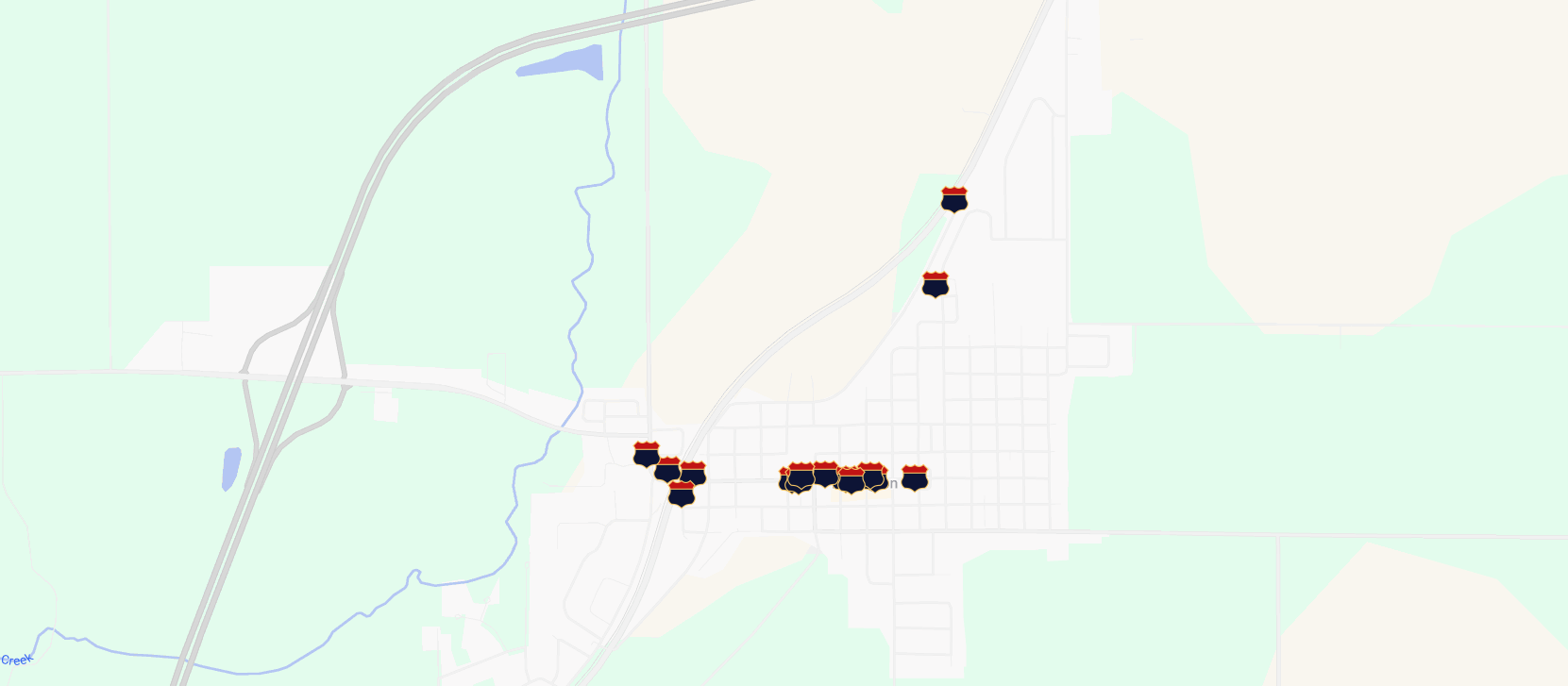
Click through the custom Google Map below to find all of the Lexington History Project signs and articles placed around town.
All Lexington History Project articles were written and edited by Nicholas Rynerson and Elizabeth MacPhail, with research and editorial contributions from THE FORT Historical and Genealogical Society in Lexington, Illinois.
A Note on Citations: All non-cited facts, dates, and addresses were provided from the archives of THE FORT Historical and Genealogical Society in Lexington, Illinois. For any additional information on specific town history, email THE FORT at thefortoflex@aol.com. For any suggested chronological changes regarding the information in this article please email nick@bolt-cutter.com.
Like this article? Download a PDF here!
Presidential Visits. Supreme Court Cases. Railroads. Route 66.
Established in 1836.